Showing posts with label Learning-focused culture. Show all posts

02 September 2021

Thinking deeply about primary education - key principles from Christopher Such (Reading)


Key principles shared by Christopher Such:

  • Be guided by research - the process of teaching reading is exceptionally complicated. Know it and let it inform your practice.
  • Teach phonics well - Essential that this is done to a high standard
  • Consider language development as a key part of reading - reading stories, openly discussing things with children
  • Developing fluency - know what it is, know how to assess it, encourage its development in children.
  • Vocabulary - embed and teach this in a way that supports vocabulary development.
  • Reading comprehension - understand and taught
  • Teach the whole class as a default.

26 September 2020

Inspiration - Dr. Jean Mitaere and the Turanga Framework

I am so grateful to my sister-in-law who shared the Turanga Framework with me on the weekend. I have been hooked ever since. Over the week I have tracked down as much information as I can about the Turanga Framework and currently looking at how I can use this as a conceptual framework in my research. 

Recently, one of my students talked about the Ula Model and how he contacted the author for clarity around the model. I took a lead from him and contacted Jean this week to set up a zoom chat. Thankfully, she said yes! Both Jean and I spent half an hour on Friday afternoon chatting about our connections in Rarotonga and Wellington. 


Ministry of Social Development. (2012). Turanga Māori: a Cook Islands Conceptual Framework transforming family violence - restoring wellbeing (Issue March). http://www.pasefikaproud.co.nz/assets/Resources-for-download/PasefikaProudResource-Nga-Vaka-o-Kaiga-Tapu-Pacific-Framework-Cook-Islands.pdf%0Ahttp://www.pasefikaproud.co.nz/

Watch the following video of Jean - she epitomises our Cook Island wit, humour and tenacity - I am so inspired!


12 September 2019

Nurturing learner agency through inquiry

Straight into the workshop with Kath Murdoch and she is challenging the group to assume at the crux of all learning is connectedness and relationships, and offers us a strategy to connect with the people in the group. 

Question swap strategy

What is one question you could ask anyone in the room in order to find out a little more about them?
Credit: kjinquiry

Write a question, find someone in the room and ask them your question, they then ask you a question - swap questions and find another person to ask your new question.


The way that you work with learners is so wound up in our beliefs about learning.


What is your image of the child?
Watch this video and identify words that describe the child.


What is the role of the teacher then?
* Facilitate the thinking
* Cultivate curiosity
* Scaffolding
* Design learning experiences that means kids are eager and hungry to find out.

How do I see the child?
How do I see myself?
How do I see the curriculum?
How do I view learning itself?
How do we see our community?


Know the curriculum so well, that you can let it go.

How well do you know the curriculum?


What is learner agency?

  • Having multiple pathways available to you?
  • Learners connecting with other learners
  • Agency means connection - self to others

Inquiry Strategy
  • THINK - Think of what 'learner agency' means to you
  • MAKE - Create your thinking using popsicle and matchsticks
  • LINK - Share your creation with another person, invite them to interpret it. You look at the other persons creation and interpret. Then find the common threads that link the understandings.

Gradual and immediate release of responsibility
Growing students learning capacity by flipping the instruction model

  • Which of these are great opening lines?
  • Share a list of opening lines from books.
  • Invite the participants to share the opening lines they like and why.
  • Write down they why words e.g. emotional, connectedness
  • Invite the participants to write their own opening line and share them..
  • Go and find more great opening lines
  • Now let's write.


20 April 2019

Everyone is advantaged by a structured literacy approach

Inquiry question: What strategies will best support students literacy learning in my class?


Bridging the gap between neuroscience, evidence-based research and classroom teaching
‘Structured Literacy approach’
Liz Kane Literacy
Tuesday 16th April 2019


Tennis Ball on Tennis Racket on Floor
Reading is like Tennis - Tennis is complex

  • Specific skills that develop to a level of automaticity
  • The strategy of how to play the game
  • We wouldn’t teach children the whole game of tennis, rather specific skills


In the same manner, we shouldn’t go to the whole to teach children to read.


Children with good memories and guessing strategies can look as though they are reading. Then you present them with words they have never seen before.
Centre for Independent studies education researcher
Jennifer Buckingham


The English alphabet has 22 letters (44) sounds and (over 200) spellings of the sounds.


What does the last 20 years of research tell us?
What happens in the brain when we learn to read?
What implications does this have in how reading should be taught?


Phonemic awareness
  • To learn the alphabet the brain first must learn to speak
  • Brain not wired for reading
  • We use circuits in the brain that we already use for recognising faces to start recognising letters
  • The challenge is to turn the letters into sounds


Dr Stanislas Deheane

Phonemes - a set of motor movements that are encoded with the sound signal
explicitly showing the movements as well as hear the sound.


Phonemic awareness - Identify and manipulate individual sounds (phonemes) in words
is a strong predictor of reading success

David Kilpatrick
Aggressively teach the code to these kids. - orthographic mapping


The English Alphabetic Code - the most complex code
Teach 5-year-olds the consonants and vowels of the word


Lesson sequence


Authors to follow up
  • The Simple view of Reading (Gough and Tunmer 1986)
  • Scarborough’s Reading Rope (2001)
  • Excellence and Equity in Literacy Education James Chapman and Bill Tunmer
  • Alison Arrow
  • Canterbury University Literacy Education
  • Maryanne Wolf


So what does this mean for me?
  • In Term 2, I am going to be very intentional about teaching ‘the code’ explicitly.
  • I am going to carry out a number of phonological awareness assessments.

11 February 2019

My Read-aloud challenge 2019

I've read this book a number of times now and totally agree with the underlying message, which I interpret to be:

Read-aloud to your children, no matter what age, it's good for them!


This year, I am challenging myself to read 3 books to my class every day! Sounds easy right?! It's so not. I tried last year and really struggled to squeeze it in. However, what I did notice was that when I read to my 5-year-olds a few times a day their 'reading stamina' - for want of a better phrase - got better and better! They were often engrossed in what I was reading and as I read some more than once, twice or even thrice, they started reading with me.

To keep myself accountable, I am going to try and document the books I read here. I am hoping to gather data on children's 'reading stamina' through weekly reflections and record their oral language development using JOST. Wish me luck!


05 December 2018

Spiral of Inquiry: Story Hui

At WRS, we've been looking at StoryHui, you can find out more here, here and here. We were first introduced by looking at this video. This has been trialled with students and teachers alike. And as a team we used the storyhui process to reflect on our Teaching as Inquiry this year. You can see my reflection below.


29 October 2018

Spiral of Inquiry: Analysing an oral language session.

As mentioned earlier, I have been enjoying Oral Language PD with Jannie Van Hees. In my last post, New learning about oral language I wrote a list of actions that I wanted to achieve by the end of the year. 

The first of these was to video a session of me working with a group of children. I then wanted to use the Vocab Profiler https://www.lextutor.ca/vp/eng/to analyse the vocabulary I used with my students.

Today I recorded a session with my class, 16 students in a multi-cultural class (many of which are emerging bilinguals). You can read the full transcript here.

Here is a summary of that analysis:


The data shows that in this 12-minute children were exposed to 1393 words and 314 different words. 

Of these 1393 words, 86.07% of the words were in the first 1-1000 frequency words, and 4.95% were in the 1001-2000 words. Only 0.50% of these words from the Academic Word List (AWL) which appear with high frequency in English-language academic texts. As you can see in the image below these words are analysis_[1] author_[2] contact_[1] demonstrate_[1] partner_[2] There were 8.47% in the Off-List Words these were allen_[3] alright_[1] ch_[1] cheep_[7] chicks_[2] chirped_[1] clues_[1] cock_[2] cockle_[3] crowed_[1] disrupting_[1] disruptive_[1] distracting_[1] doo_[5] doodle_[5] fluffy_[1] gingers_[3] hen_[10] hens_[3] ikihele_[4] illustrator_[1] leghorn_[12] leghorns_[2] neighbouring_[1] nikau_[2] nooooo_[1] okay_[17] oral_[2] pamela_[3] preened_[2] preening_[4] redhead_[1] rooster_[1] session_[1] shed_[3] sided_[1] sill_[1] ta_[2] um_[2] yeah_[3]. Children were exposed to many of these words through the read-aloud story. Our Junior team has committed to reading aloud to children every day, and you can see in the transcript this is having significant benefits to children's understanding of various words. For example;
Teacher: So the little red hen carefully stretched and preened one wing, then carefully stretched and preened the other wing and when she was quite sure she was neat and tidy. Remember what preening looks like? Child T: Yeah. Teacher: Show me, show me with your body preening when the Little Red Hen is preening. What's she doing? She's doing it like this….preening.Child Ta: She’s covering it.Teacher:  Yeah, it looks like this.That’s  a great way to demonstrate that for us D.

Reflections:

  • What can I do to ensure that ALL children a contributing to dialogue?
  • The most common word in this text is "and, are, a" - what do I need to do to introduce a range of other words?
  • What makes some children more confident to speak up than others?

16 October 2018

Spiral of Inquiry: New Learning about Oral Language

I had the great pleasure of attending a day long PD with Janie Van Hees today. While my brain is absolutely overloaded, I will attempt to share my key takeaways and actions from the day.

What is the role of talk?
  • More ideas shared
  • More words used
  • Greater quality words
  • more ‘to and fro’ talk with your child
Quotes that provoke!Its never too late! Be relentlessHigh expectations and delicious learning available to all tamariki.Surfing to comprehend, and surfing them back again…

Talk accompanied print is the difference maker

Why does spoken language matter? And what does it offer?

60-70% of my environment has to have ‘others’ language available to me

30% me trying it out

The role of talk
  • More ideas shared
  • More words used
  • Greater quality words
  • more ‘to and fro’ talk with your child
Your child hearing and saying reading and talking about reading with you and other sets them up for literacy and learning.
  • Knowledge gap - language is a critical contributor to the knowledge gap.
  • Oral language is a way to grow your thinking.
  • Lived experiences: fluffy sheep or smelly cow
  • Extended daily conversations


Teacher Attention
  • Attention to and noticing
  • Effortful and purposeful engagement and interaction
  • all participating
  • Triggering the ‘known’ to connect to the ‘new’
  • Stretching the learners current language repertoire
  • Multiple encounters
  • Context relevant
  • Facilitated through engaging mediating tools - persons, tasks, activities, sources.

Learner Attention
  • Focus and Notice
  • Put in the effort
  • Take part (participate) fully
  • Push myself to the edge
  • Dig deep for what I already know
  • Learn from others - notice and focus
  • I share - others gain from me
  • Think and talk; think and read
  • Wondering and asking opens up possibilities to know
Classroom talk
  • More time to process
  • Think to yourself, share with someone else and then share with someone else
  • First, second, third


A dialogic gifting exchange might go like this:
Lets all look carefully at the photo, really closely and think and look for details. Dig deep and notice whats going on…use your brain and your eyes to see and think about what the photo is telling us

Ill give you a good amount of think and look with all your brain. Get your ideas ready for sharing. So thinking and looking deeply as much as your bring can AND getting some of your ideas ready to tell someone else. Use gestures

Okay everybody, let's make sure we have on fabulous idea ready to tell another person. Remember how we get a fabulous idea ready.

Children show they know by putting their thumb up.
Teacher: Oh…so many of you remember. Tiaki, you tell us what we need to do to get a fabulous idea ready to tell someone.

Tiaki: We need to use words so they can know what we mean.

During teaching and learning/Dialogic gifting in class

Why do we keep asking so many questions? We should be in dialogue with our children

Example of dialogic gifting
Teacher: Sea horses are amazing animals. Remember how we read that they propel themselves through the water with the tiny fin on their back

Child: The fin flutters really quickly. It uses it for steering.

Teacher: Yes, I used the word propelling and you used the word steering, the fin helps it go left and right.

Teacher: It does, it has some other fins too. I wonder who can remember the name of those fins. We read that word.

CHild: P…. Pec… Pec Oh I can't say it

Teacher: Pectoral fins, clever, good remembering now let's talk about the tail and how 

The point is: When we have exchanges of ideas in the classroom, could we better at being responsive and adding to the kaupapa and the meaning.

High level vocabulary: Groups of words e.g. feeds no plankton, steady itself to eat, curly, scaly tail, fin flutters, seahorse is a fish

There have been some amazing words that we’ve used, lets remember some of them.

Lets explain that word - vocabulary
Like …. is an example.


Actions:
  • Meaning making ready and explain ready rather than reading and writing ready
  • JOST in different languages e.g. Tongan/Samoan
  • Toy Library @ Wymondley
  • Re-word testing: gathering information
  • Video myself 
  • Create a framework of things to look for in my video analysis.
  • We choose best words to say what we mean, really say what we mean
  • Acknowledge what the child says and open it up for further comment
  • Students to do the heavy lifting
  • Provide quantity and quality in the schooling environment
  • Visuals: Ask what's going on in the photo, what else are you thinking?


17 September 2018

Spiral of Inquiry: Taking action with Oral Language

Taking action
What can we do differently to make enough of a difference? "Genuine inquiry needs space to take risks, make mistakes, and try again – and again". Changing things can also feel risky for some learners who then resist change, and in turn, bring concerned parents. We need to build understanding for all, right from the outset.


So I've had a bit of a lull with my inquiry, mostly because I have been somewhat resentful about having to explicitly teach Oral Language in my classroom. I know I'm not the only one, as we've discussed this at a recent OCoL but the fact of the matter is that oral language is the foundation to reading and writing, and it is vital that children have the oral language to support their ongoing learning.

So, I have been using Time to Talk to guide my 'oral language sessions' and have adapted this to suit my class. Some of our lessons include explicit modelling of conversations and rules for listening (among other things). I am repeating the lesson several times so that children are getting repetition and lots of practice.


I have really played up the idea of 'respectful listening'. What does this mean? Well, Gingers rules for listening are:

1. Look with your eyes
2. Listen with your ears
3. Keep still
4. Be quiet

As a class, we have added 'Be respectful'. Which means focus on the speaker and listen intently.

It seems contradictory to have such a structured oral language programme in a play-based classroom but the role modelling of explicit language conventions seems to support our language in all areas of our classroom. The evidence is quite fascinating.
I have been using JOST (Junior Oral Language Assessment) to measure progress in oral language. Below is an example of the shifts made in an oral story with picture prompt:

May 2018 "The boy is wet".
September 2018 "The girls in the window she's angry at the boy because he took his shoes off and jumped in the water".


In addition to a rich language focussed, play-based programme and lots of 'read aloud' opportunities, the Time to Talk programme has been a good reminder to me of the importance of oral language.

Below are samples of progress in oral language of children in my class.


The areas in which I need to really focus on are:

* All body parts (chin, elbow and little finger) seem to be a struggle for new students.
* Plurals - 1 boat - 2 boats, 1 bus - 2 buses, 1 mouse - 2 mice
* Prepositions - in, under, beside, behind etc
* Tense - jump|ed, fall|fell, find|found, clap|clapped.

So while lots of action has been taken I am looking at ways to support children with specific aspects of their oral language development.

This week I am at a professional development session with Jannie Van Hees and I look forward to implementing my new learning into my classroom.


01 September 2018

Spiral of Inquiry: More learning about Phonemic awareness

Yesterday I came across a Facebook post in the Learning through Play page that asked about 'readiness for reading' in a play-based classroom. There was a range of really useful information and most confirmed my hunch around phonemic awareness. I really enjoyed seeing how the teachers in the following video integrated the phoneme levels into their everyday routines like reading.


Phoneme level is the most important level of phonological awareness, the four aspects of these are:

Phoneme Identity: Helping children identify single sounds in words
Phoneme Segmentation: Break a word up into all of its individuals sounds
Phoneme Blending: Blending individual sounds together to form a word
Phoneme Manipulation: Playing with sounds and words.


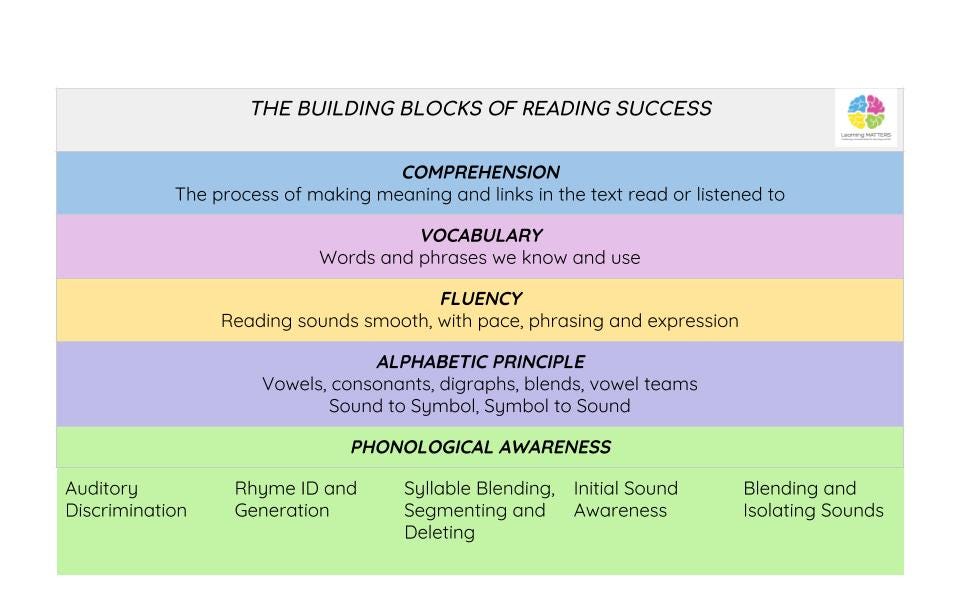
The diagram below shows the building blocks of reading success: 


Reading is not creating something completely novel, reading consists of connection and creating an interface between vision and the spoken language system.

There are parts of the brain that are only activated by those who know how to read e.g. visual recognition of letters.

And perhaps the biggest message of all by Prof. Sanislas Dehaene...

Phonics is superior to whole-world training!

Image result for the brain architecture for reading

No automatic alt text available.

24 July 2018

Spiral of Inquiry: Learning about Oral Language

If you've been following my blog over the years, you will know that I have been a real advocate for Oral Language, especially in the form of Digital Storytelling.

Did you know that kids growing up in poverty hear 30 million fewer words by age 3? The 'word gap' has been a rhetoric in schools for the longest of time. Especially in South Auckland (low-socioeconomic area in New Zealand), however, this article found in MindShift challenges this widely known fact, and states that the study was done 40 years ago with only 42 families.


However, in my new role as new entrant teacher, it's pretty obvious, regardless of the study that Oral Language in our young people is in dire straits! 

I thought I knew about Oral Language, I thought I knew how to foster it, but it seems that I actually need to be more strategic and intentional in the teaching of oral language (how did it come to this?)


So I've read a range of books and watched a number of videos to explore how this might work for my class, and have created a booklet with 20 Ideas to Support Oral Language. At our recent OCoL (Otara Continuity of Learning) we looked at oral language across settings (early childhood and primary school). With my head full of ideas and possibilities I called on a team of people to help me whittle down the key practices and package all of this information into a session or programme in my class.

So our Speech Langauge Therapist (SLT), the Resource Teacher of Learning and Behaviour (RTLB), and the Psychologist met over the holidays to look at a programme. We have chosen to go with "Time to Talk" by Alison Schroeder. It looks like it will be a great way to intentionally teach oral language and create ways for whānau to be engaged too.


In addition to this, I am also enrolled in this exciting opportunity to work with a team of people and alongside Jannie Van Hees who is world-renowned for her work on oral language and vocabulary.

So, there are lots of opportunities for learning this year! I look forward to reporting on this new learning and the impact it will have on my students learning.

17 June 2018

Spiral of Inquiry - Learning about Phonemic Awareness - Part 2

Phoneme awareness is the single biggest indicator of success in reading - Maria S. Murray, Ph.D.
This video is helpful for learning the difference between phonemic and awareness and phonological awareness. If you have a spare hour (who does?) this is well worth watching.


Here are some of the key slides from the presentation:


So what does this mean for me and my practice?
Using the Developmental sequence of Phonological skills I would like to look at each of my learners to see how and where they fit into this continuum and intentionally using this information in my phonological/phonemic awareness planning.