Showing posts with label Professional inquiry. Show all posts

16 September 2021

Te Tiriti o Waitangi partnership - stepping up and calling myself out!

Recently I've been talking about the Code and Standards with my tauira at TWoA. I'm pretty proud of the fact that I have been keeping a reflective journal since the early 2000s and took this online in 2008. Although some of my earlier posts are hardly worth mentioning ;) In my defence it was in the early days of Blogger. Fast forward to 2021 and I find myself reflecting on the Codes and Standards again. I and realise that I have made little to no progress in the Te Tiriti o Waitangi space (the labels world cloud proves that!) - certainly not as much as I could have or should have at this stage in my career. Hei aha, this post is about me calling myself out and setting professional goals in this space.


Here is what the profession demands for Te Tiriti o Waitangi partnership

Understand and recognise the unique status of tangata whenua in Aotearoa New Zealand. 

  • Understand and acknowledge the histories, heritages, languages and cultures of partners to Te Tiriti o Waitangi. 
  • Practise and develop the use of te reo and tikanga Māori. Demonstrate commitment to tangata whenuatanga and Te Tiriti o Waitangi partnership in Aotearoa New Zealand.


Reflection - 2018

I am privileged to be of Maori descent. My father is a descendant from Ngāpuhi and grew up in Kaikohe and Whangarei. I use Te Reo Maori and practice Tikanga Maori in all of my teaching practice and everyday interactions. This 'standard' is of significance to me professionally and personally, so I will look at further opportunities to embed this in my everyday practice.

Reflection - 2021

I'm calling myself out for not doing enough for Te Ao Māori and Te Tiriti o Waitangi. While there are a number of reflections on this blog it really isnt good enough! Being Māori isn't really enough in 2021! You have to actively and intently invest time into Te Reo Māori and so this is the start of my next professional (and personal) goal. 25 minutes every day invested in Te Reo Māori - be intentional, be committed! Stay tuned for my development.


15 August 2020

Pondering my research topic....again!


I have heard the rumours that your initial thinking around your research topic will most definitely change as you refine your thinking in your research area. I have always been open to this...and have on many occasions stated my topic is "Listening as a leadership skill" BUT I'm not married to it. As I spend some time in my study cave this weekend I am currently looking at my research design. The following quote captured my attention:
Ignoring design is one way of saying openly to the world – ‘I don't care about the quality of my research, the wasted opportunities it represents, the waste of peoples’ time participating in or reading it, or the dangers to the very people that the research is meant to help’. (Gorard, 2017, p. 4)
Talk about, no pressure! So, here I am on a beautiful Saturday morning (in Level 3 lockdown imposed on Auckland, NZ last night for what will be 2 weeks) pondering my research topic...again!

I have found many of the articles selected by my lecturer to be spot on in terms of getting to the point about what is required and offering alternative thoughts on long-held myths - such as...

There are 3 types of research designs - quantitative, qualitative and mixed methods. No, this is not the case. Nice to know that now, given I have actually done 2 other 'research' papers in the past in my previous study. 

So, in a bid to add some structure into my thinking process I am going to use the questions asked by (Cohen et al., 2018) to help surface my thinking...
It is vital that the researcher knows what she or he wants the research to ‘deliver’, i.e. to answer the question ‘what are the “deliverables” in the research?’ (Cohen et al., 2018, p. 157)
What do we want to know as a result of the research that we did not know before the research commence?
  • To have some clarity around a definition of listening - but after reading a few readings maybe I mean conversations or dialogue?
  • To understand leaders perceptions of listening and their role in listening?
  • To create a model of listening for leaders?
  • To understand the impact of listening on teachers when leaders listen? (maybe this is not an immediate question but something to keep in the back of my mind)
What do we want the research to do? 
  • Define listening in an educational context
  • To support participants in understanding their own listening behaviours
  • Offer a multi-cultural perspective to listening
What do we want the research to find out?
  • Listening to understand what does this look like, feel like, sound like for leaders?
  • How might listening impact on collegiality and collaboration?
  • What are the insights/reflections that can be revealed from hearing participants stories?
Further points to consider:

Access - "A formidable issue to be faced here is one of access. Many new researchers fondly imagine that they will be granted access to schools, teachers, students, parents, difficult children, students receiving therapy, truants, dropouts, high performers, star teachers and so on. This is usually NOT the case: gaining access to people and institutions is one of the most difficult tasks for any researcher, particularly if the research is in any way sensitive" (Cohen et al., 2018, p. 158)

Positionality - As the researcher, I need to consider my own limitations, values and belief and ensure that my biases are in check. For example - I believe wholeheartedly in coaching as a way of increasing self-directed humans. This may impact my motivations in uncovering the importance of listening as a leadership skill e.g. I want to hear what I want to hear.

The benefits - What are the benefits of the researcher to me? Gaining a better understanding of 'listening' as a skill will eventually support me in my own coaching skills. I am really excited about carving out time and space to read up on (literature review) a topic that I find incredibly fascinating. The side benefit to this is that I also will accomplish the requirements for a Master of Education Leadership degree.

Availability - How available am I to conduct this research. Given the parameters of what I want to achieve what is realistic? I work full-time and also have Kia Mahira (where I coach several clients) and run workshops. I will happily read and read and read on a topic of interest. I need to consider what I want to achieve and whether this is feasible in terms of time/and participants time.

Boundaries - "As the saying goes, ‘the best way to eat an elephant is one bite at a time’! Researchers must put clear, perceptible, realistic, fair and manageable boundaries round their research". (Cohen et al., 2018, p. 160)

Research questions: Questions such as ‘what is happening?’, ‘what has happened?’, ‘what might/will/ should happen?’ open up the field of research questions. ‘what are the effects of such- and-such a cause?’ and ‘what are the causes of such- and-such an effect?’ are two such questions, to which can be added the frequently used questions ‘how?’ and ‘why?’. These questions ask for explanations as well as reasons. Many of the most useful pieces of research stem from complex issues, complex research questions and
‘difficult- to-answer’ research questions. (Cohen et al., 2018, p. 161)

References:

Cohen, L., Manion, L., & Morrison, K. (2018). Choosing a research project. In L. Cohen, L. Manion, & K. Morrison (Eds.), Research methods in education (Eighth edi, pp. 153–164). Routledge.

Gorard, S. (2017). What is Research Design? Research Design: Creating Robust Approaches for the Social Sciences, 2–12. https://doi.org/10.4135/9781526431486.n1


12 September 2019

Nurturing learner agency through inquiry

Straight into the workshop with Kath Murdoch and she is challenging the group to assume at the crux of all learning is connectedness and relationships, and offers us a strategy to connect with the people in the group. 

Question swap strategy

What is one question you could ask anyone in the room in order to find out a little more about them?
Credit: kjinquiry

Write a question, find someone in the room and ask them your question, they then ask you a question - swap questions and find another person to ask your new question.


The way that you work with learners is so wound up in our beliefs about learning.


What is your image of the child?
Watch this video and identify words that describe the child.


What is the role of the teacher then?
* Facilitate the thinking
* Cultivate curiosity
* Scaffolding
* Design learning experiences that means kids are eager and hungry to find out.

How do I see the child?
How do I see myself?
How do I see the curriculum?
How do I view learning itself?
How do we see our community?


Know the curriculum so well, that you can let it go.

How well do you know the curriculum?


What is learner agency?

  • Having multiple pathways available to you?
  • Learners connecting with other learners
  • Agency means connection - self to others

Inquiry Strategy
  • THINK - Think of what 'learner agency' means to you
  • MAKE - Create your thinking using popsicle and matchsticks
  • LINK - Share your creation with another person, invite them to interpret it. You look at the other persons creation and interpret. Then find the common threads that link the understandings.

Gradual and immediate release of responsibility
Growing students learning capacity by flipping the instruction model

  • Which of these are great opening lines?
  • Share a list of opening lines from books.
  • Invite the participants to share the opening lines they like and why.
  • Write down they why words e.g. emotional, connectedness
  • Invite the participants to write their own opening line and share them..
  • Go and find more great opening lines
  • Now let's write.


20 April 2019

Everyone is advantaged by a structured literacy approach

Inquiry question: What strategies will best support students literacy learning in my class?


Bridging the gap between neuroscience, evidence-based research and classroom teaching
‘Structured Literacy approach’
Liz Kane Literacy
Tuesday 16th April 2019


Tennis Ball on Tennis Racket on Floor
Reading is like Tennis - Tennis is complex

  • Specific skills that develop to a level of automaticity
  • The strategy of how to play the game
  • We wouldn’t teach children the whole game of tennis, rather specific skills


In the same manner, we shouldn’t go to the whole to teach children to read.


Children with good memories and guessing strategies can look as though they are reading. Then you present them with words they have never seen before.
Centre for Independent studies education researcher
Jennifer Buckingham


The English alphabet has 22 letters (44) sounds and (over 200) spellings of the sounds.


What does the last 20 years of research tell us?
What happens in the brain when we learn to read?
What implications does this have in how reading should be taught?


Phonemic awareness
  • To learn the alphabet the brain first must learn to speak
  • Brain not wired for reading
  • We use circuits in the brain that we already use for recognising faces to start recognising letters
  • The challenge is to turn the letters into sounds


Dr Stanislas Deheane

Phonemes - a set of motor movements that are encoded with the sound signal
explicitly showing the movements as well as hear the sound.


Phonemic awareness - Identify and manipulate individual sounds (phonemes) in words
is a strong predictor of reading success

David Kilpatrick
Aggressively teach the code to these kids. - orthographic mapping


The English Alphabetic Code - the most complex code
Teach 5-year-olds the consonants and vowels of the word


Lesson sequence


Authors to follow up
  • The Simple view of Reading (Gough and Tunmer 1986)
  • Scarborough’s Reading Rope (2001)
  • Excellence and Equity in Literacy Education James Chapman and Bill Tunmer
  • Alison Arrow
  • Canterbury University Literacy Education
  • Maryanne Wolf


So what does this mean for me?
  • In Term 2, I am going to be very intentional about teaching ‘the code’ explicitly.
  • I am going to carry out a number of phonological awareness assessments.

05 December 2018

Spiral of Inquiry: Story Hui

At WRS, we've been looking at StoryHui, you can find out more here, here and here. We were first introduced by looking at this video. This has been trialled with students and teachers alike. And as a team we used the storyhui process to reflect on our Teaching as Inquiry this year. You can see my reflection below.


08 November 2018

Spiral of Inquiry: Another day with Jannie van Hees (Oral Language)


Relationships with all key stakeholders takes time.
If you hope it happens, it won't!

Have a look at all of the children across your school that need extra support - identify the patterns and the trends? 

Phonological understanding of children is based on the quality of the oral language interactions of children and their engagement in talk accompanied print.

We've got no idea how capable their brain is, we need to have high expectations and keep believing. We have to see an unsung potential here and we need to see what that is! Every child has potential - Jannie Van Hees


A young child's brain development
Growing our children's language potential
Rich social interaction 
Responsible caregivers
Quality talk with child
Reading with talk support
SHAPES the CIRCUITRY of a child's brain

Conversational teaching and learning?
Dialogic teaching and learning?
What do high-quality conversations look like? and what does it do?

If you just listen to a story, you won't get as much out of as if you stopped and talked about it e.g. text accompanied print.

Instead of saying "listen" say "Victoria is talking, let's focus and notice so that we can respond". Paraphrase what Victoria says and invite more dialogue from students.


TAKEAWAYS

  • Be intentional in choosing books 
  • Develop a list of high-quality stories for Book talk
  • Can books be organized into themes?
  • It's never too early to read to a child
  • The quality and quantity of language counts
  • Put the time and effort in if you want outcomes
  • Reading to children is a skill, use it as an opportunity to have a conversation
  • Read for enjoyment!
  • You don't have to DO a book, experience a book!
  • Small group sizes are optimal
  • Children's knowledge is gained through language, and in particular 
  • Choose word groups rather than single words (the more we bring it to the foreground, the more children will)
  • Teach children to hunt for 'word groups'
  • Children thrive when they are taken to new learning
  • How do we lead children to new knowledge?
  • Play-based learning - how can we ensure deliberate acts of teaching and learning and provide new learning opportunities for ALL children.
ANALYSING TEXTS

Today in our workshop we looked at Perky the Pukeko and analysed for concepts and high-vocabulary.

WOW!! What an amazing experience and an exciting way to really look at how we might bring vocabulary and concepts to the fore for our students. You can see examples of how this played out for us today, below:


ACTIONS
  • Explore possibilities to develop a stronger relationship with local early childhood centres e.g. cross-collaboration between school/early childhood education centre.
  • What might whānau workshops look like at Wymondley in relation to oral language?
  • Identify Goals for 2019! with dates and plan of action.
  • Ensure everyone is on board with this!
  • Diary dates in with all of the key stakeholders, this year for next year.
  • Analyse books and look for opportunities to bring to the fore vocabulary and concepts for students.

29 October 2018

Spiral of Inquiry: Analysing an oral language session.

As mentioned earlier, I have been enjoying Oral Language PD with Jannie Van Hees. In my last post, New learning about oral language I wrote a list of actions that I wanted to achieve by the end of the year. 

The first of these was to video a session of me working with a group of children. I then wanted to use the Vocab Profiler https://www.lextutor.ca/vp/eng/to analyse the vocabulary I used with my students.

Today I recorded a session with my class, 16 students in a multi-cultural class (many of which are emerging bilinguals). You can read the full transcript here.

Here is a summary of that analysis:


The data shows that in this 12-minute children were exposed to 1393 words and 314 different words. 

Of these 1393 words, 86.07% of the words were in the first 1-1000 frequency words, and 4.95% were in the 1001-2000 words. Only 0.50% of these words from the Academic Word List (AWL) which appear with high frequency in English-language academic texts. As you can see in the image below these words are analysis_[1] author_[2] contact_[1] demonstrate_[1] partner_[2] There were 8.47% in the Off-List Words these were allen_[3] alright_[1] ch_[1] cheep_[7] chicks_[2] chirped_[1] clues_[1] cock_[2] cockle_[3] crowed_[1] disrupting_[1] disruptive_[1] distracting_[1] doo_[5] doodle_[5] fluffy_[1] gingers_[3] hen_[10] hens_[3] ikihele_[4] illustrator_[1] leghorn_[12] leghorns_[2] neighbouring_[1] nikau_[2] nooooo_[1] okay_[17] oral_[2] pamela_[3] preened_[2] preening_[4] redhead_[1] rooster_[1] session_[1] shed_[3] sided_[1] sill_[1] ta_[2] um_[2] yeah_[3]. Children were exposed to many of these words through the read-aloud story. Our Junior team has committed to reading aloud to children every day, and you can see in the transcript this is having significant benefits to children's understanding of various words. For example;
Teacher: So the little red hen carefully stretched and preened one wing, then carefully stretched and preened the other wing and when she was quite sure she was neat and tidy. Remember what preening looks like? Child T: Yeah. Teacher: Show me, show me with your body preening when the Little Red Hen is preening. What's she doing? She's doing it like this….preening.Child Ta: She’s covering it.Teacher:  Yeah, it looks like this.That’s  a great way to demonstrate that for us D.

Reflections:

  • What can I do to ensure that ALL children a contributing to dialogue?
  • The most common word in this text is "and, are, a" - what do I need to do to introduce a range of other words?
  • What makes some children more confident to speak up than others?

01 September 2018

Spiral of Inquiry: More learning about Phonemic awareness

Yesterday I came across a Facebook post in the Learning through Play page that asked about 'readiness for reading' in a play-based classroom. There was a range of really useful information and most confirmed my hunch around phonemic awareness. I really enjoyed seeing how the teachers in the following video integrated the phoneme levels into their everyday routines like reading.


Phoneme level is the most important level of phonological awareness, the four aspects of these are:

Phoneme Identity: Helping children identify single sounds in words
Phoneme Segmentation: Break a word up into all of its individuals sounds
Phoneme Blending: Blending individual sounds together to form a word
Phoneme Manipulation: Playing with sounds and words.


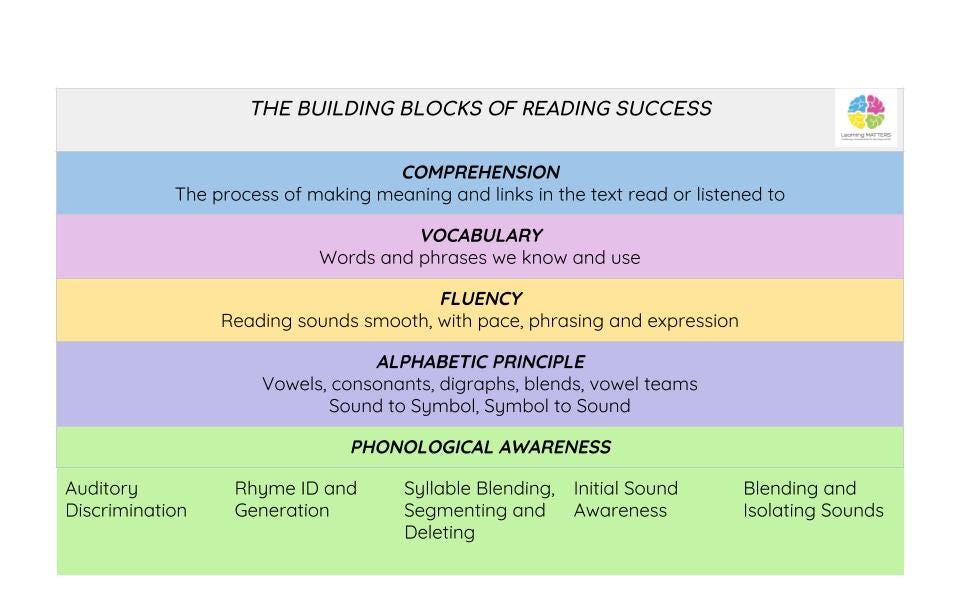
The diagram below shows the building blocks of reading success: 


Reading is not creating something completely novel, reading consists of connection and creating an interface between vision and the spoken language system.

There are parts of the brain that are only activated by those who know how to read e.g. visual recognition of letters.

And perhaps the biggest message of all by Prof. Sanislas Dehaene...

Phonics is superior to whole-world training!

Image result for the brain architecture for reading

No automatic alt text available.

24 July 2018

Spiral of Inquiry: Learning about Oral Language

If you've been following my blog over the years, you will know that I have been a real advocate for Oral Language, especially in the form of Digital Storytelling.

Did you know that kids growing up in poverty hear 30 million fewer words by age 3? The 'word gap' has been a rhetoric in schools for the longest of time. Especially in South Auckland (low-socioeconomic area in New Zealand), however, this article found in MindShift challenges this widely known fact, and states that the study was done 40 years ago with only 42 families.


However, in my new role as new entrant teacher, it's pretty obvious, regardless of the study that Oral Language in our young people is in dire straits! 

I thought I knew about Oral Language, I thought I knew how to foster it, but it seems that I actually need to be more strategic and intentional in the teaching of oral language (how did it come to this?)


So I've read a range of books and watched a number of videos to explore how this might work for my class, and have created a booklet with 20 Ideas to Support Oral Language. At our recent OCoL (Otara Continuity of Learning) we looked at oral language across settings (early childhood and primary school). With my head full of ideas and possibilities I called on a team of people to help me whittle down the key practices and package all of this information into a session or programme in my class.

So our Speech Langauge Therapist (SLT), the Resource Teacher of Learning and Behaviour (RTLB), and the Psychologist met over the holidays to look at a programme. We have chosen to go with "Time to Talk" by Alison Schroeder. It looks like it will be a great way to intentionally teach oral language and create ways for whānau to be engaged too.


In addition to this, I am also enrolled in this exciting opportunity to work with a team of people and alongside Jannie Van Hees who is world-renowned for her work on oral language and vocabulary.

So, there are lots of opportunities for learning this year! I look forward to reporting on this new learning and the impact it will have on my students learning.

07 May 2018

A change of direction in my inquiry..

I recently wrote about my hunch around Guided reading in my class and the impact this might have on the learning progress of my students. I've attended a couple of webinars about Guided Reading - one with Fountas & Pinnell here and one I wrote about here with Create-Abilities and I am slowly becoming more familiar with this as a teaching strategy. 

I have my station all set up with my Reading Progress booklets, my highlighters, my guided reading templates reference sheet and my levelled books and my super keen students who love the idea of taking books home. 


AND THEN...I saw this...and as any overworked, time deficient teacher does - I read through the comments, and read and read and read... 


I have to admit, I have lived in the 'whole language' camp for many years and have recently realised (after studying) that children actually require a balanced approach an either/or approach just won't cut it anymore. Unfortunately, this seems to be a political football in NZ, and the whole vs phonics approach has left teachers feeling disillusioned and confused. 


This article got me thinking about phonics, phonemic awareness and letter identification (which is an assessment used in the Observation Survey by Marie Clay/Reading Recovery work). Some of my children are reading, but the comments section of this post got me thinking. Are my learners guessing or reading? In my class, we have a lot to work on with regard to Letter Identification. For those of you who haven't seen this assessment (see below), to administer this assessment you ask the learner to read the letters on a line and then you gradually go down as they read across, obviously, the letters are not in alphabetical order rather they are jumbled. There are a total of 54 symbols and children are given a point if they can name the word, give the sound or give it in a word.  


The comments and related articles suggest that it is much more important for children to 'decode' texts. That is, understand letter sounds associations. So, with this in mind, it looks like my second inquiry might take on a new direction. My new sub-question will be:

Overarching inquiry
What strategies are most effective when supporting WRS learners with reading?" 

Sub-question Two:
Will regular phonemic awareness sessions improve students letter/sound identification? 


27 February 2018

Spiral of Inquiry

Lynne recently introduced our team to the Spiral Inquiry through a paper entitled "A framework for transforming learning in schools: Innovation and the spiral of inquiry" In this paper, the notion of inquiry is visually more representative of a true inquiry, rather than a perfect cycle of steps, the visual shows a 'spiral' I believe inquiry to be more like a 'bowl of spaghetti'.  


The six parts of the spiral of inquiry are:

Scanning
What’s going on for learners? More emphasis is placed on teacher observations of students, in all circumstances. There are some difficult questions to ask, such as: Is it all right for some learners to experience challenging and engaging learning in one classroom while in the room next door the students are not? Scanning is not done overnight, can last two months, and may turn up surprises.

Focusing
Where will concentrating our energies make the most difference? Focusing well will lead to informed actions, and usually means selecting no more than one or two areas so that the inquiry is "focused and deep". The authors point out that a common focus generates the momentum to transform schools.

Developing a hunch
How are we contributing to the situation? "Hunch" is an important word – hunches may not be totally accurate, but it is essential to get them all on the table because they guide the focusing. Sometimes they might be well-established routines of the school or the classroom, and be relevant to your own school. Hunches need testing.

New learning  
How and where will we learn more about what we do? Teacher learning must be connected to identified learner needs. External expertise is important here and the school must make clear to externals what makes a difference to learners. We all need to know why new ways of doing things are better than what we did before.

Taking action
What can we do differently to make enough of a difference? "Genuine inquiry needs space to take risks, make mistakes, and try again – and again". Changing things can also feel risky for some learners who then resist change, and in turn bring concerned parents. We need to build understanding for all, right from the outset.

Checking  
Have we made enough of a difference? Checking doesn’t have to be formal, or at a set time. It can go on throughout the spiral. The importance of trust should be a recurring theme throughout the cycle, and it certainly is true of checking.

As I progress through the year, I'll be reporting more on each step and hyperlinking these posts back to this original post.