Showing posts with label Design for learning. Show all posts

22 November 2021

Master Your Mind, Business & Wealth by Richard Maloney

I'm attending another coaching webinar Master Your Mind, Business & Wealth with Richard Maloney. Richard is the Founder and CEO of Quality Mind. The questions he posed at the beginning of the session were:

* What were/are your dreams?

* What's held/holding you back?

He then started to unpack the reason why we might be achieving our goals and encourages us to think about our behaviors holistically, taking note of our mind, body, and soul. 

"Where your energy flows your focus goes"


1. Thought >> change your thought's to change the downward spiral.

2. Sensation

3. Mood

4. Anxiety

5. Panic attack

6. Depression

Create habits and routines >> the brain loves the change >> rewire your thoughts!


Everything we learn by 7 year olds impacts the trajectory of our lives.

Two ways to change > Hypnosis & Repitition and programming

1. What you think is what you get

2. Busting through your hidden barriers

3. Scaling your business to create wealth

Time, Wealth & Lifestyle

* What's the problem I'm solving?

* Create a step-by-stem proven system

* App & Backend Technology (website, learning management system, app)

* Mind-mentor guidance

* Like-minded community

* Scientific proof


03 May 2021

What is the purpose of school? Guy Claxton and Kath Murdoch


Kath asked Guy the following question: What is the purpose of school in 2021?
School should be a well-designed set of gears, and the most important gear is the purpose.
We are supporting parents in preparing students for life. So, what do students need to know, to do, and to be like to flourish now and in the future?
Education has multiple components in terms of knowledge, competence and character.

What do we think ALL of our kids are likely to need to flourish? 


A learning framework

Dispositions underpin success in life more - curiosity, determination, are like a big fish at the bottom of the river. Keep an eye on the bottom of the river.  Look at the whole of what's going on.


27 September 2020

Decisions! Decisions! Decisions!


There are so many decisions to make when undertaking research, It feels like 1,000,000 micro-decisions that need to be defended at any time. Lecompte & Pressie, (1993) cited in Mutch, (2013) shared a list of 7 decisions that all researchers need to make (and eighth one added by Mutch). I will attempt to answer these over the weekend (I am in my study cave), I do argue however that there are more micro-decisions made throughout this process, which I hope to reveal in the sections below or in further posts.

Research Question: How do Cook Island leaders in New Zealand primary schools understand listening as a leadership skill?

1. Formulating the problem
We often hear how communication skills are essential for leadership, but I wonder about the importance we place on listening.

2. Selecting the research design
I will be using the Turanga Framework to guide my work (a Cook Island framework developed by Dr. Jean Mitaera).

3. Choosing who and/or what to study
I have experience across early childhood primary and tertiary. Of all of these sectors, I am most interested in primary school education (for now).

I still have some thinking to do around the following questions (will save for another post).
4. Deciding how to approach participants
5. Selecting a means to collect the data
6. Choosing how to analyse the data
7. Interpreting and applying the analysis
8. Disseminating the findings

References:

LeCompte, M. D., & Preissle, J. (1993). with Tesch, R.(1993). Ethnography and qualitative design in educational research, 2.

Mutch, C. (2013). Doing educational research. Nzcer Press.

01 September 2020

Learning about research ethics - My notes


The Whakapapa of Ethics
Nuremberg Code - in the context of human rights against humanity by Nazi's of World War II
Experimentation on cocentration camp prisoners with out consent, most suffere
Two of ten principles
•The voluntary consent of the human subject is absolutely essential.
•The experiment should be so conducted as to avoid all unnecessary physical and mental suffering and injury.
Behavioural experimentation like the study of feral child Genie in the 1970s 
Strong emphasis on medical and physical sciences in terms of ethical decision making
Increase in ethical review boards
Ethics is becoming a marker of research quality

THINK ABOUT ETHICS AS 'HOW CAN I DO THE BEST POSSIBLE FOR RESEARCH PARTICIPANTS' RATHER THAN COMPLIANCE.


Other points to consider:
  • Consider the Education Council values when thinking about how to best serve research participants (in fact I am making a commitment to using these in the design of my research).
  • Do Ethics because it is a good thing to do because you want to do right by your participants (links to Sonja Macfarlanes korero about mana-enhancing).
  • Researching in a pandemic - challenges of online interviewing, extra pressures on participants, how do you create that relationship with participants through zoom?
  • Informed and voluntary consent - people have a right to know and a right to decide.

Things I will action:
  • Review the purpose of my research to ensure it is fully mana-enhancing.
  • Research adequacy - make sure you make good use of peoples times.
  • What are the experiences of leaders with listening? What are their perspectives? Focus on their own stories about their experiences (rather than commenting on how others have listened to them).
  • AIM to have EA1 by or 9th November or 24th November 2020
  • Review the Ethics Principles  https://www.aut.ac.nz/research/researchethics/guidelines-and-procedures#2

Brown, C., Spiro, J., & Quinton, S. (2020). The role of research ethics committees: Friend or foe in educational research? An exploratory study. British Educational Research Journal, 46(4), 747-769. https://doi.org/10.1002/berj.3654

Smith, L. T. (2006) Researching in the margins: Issues for Māori researchers: A discussion paper, ALTERNATIVE 2(1), 4-27.

23 August 2020

Research Methods (my preliminary ideas)

I'm back into my study cave today and I am currently looking at the methods I might use for my upcoming research project. There are a number of methods that appeal to me in theory and today I am delving in a bit more to figure out which of these might be more useful/purposeful for me and this study.

* Autoethnographic research
* Case Study
* Phenomenology
* Narrative research
* Grounded Theory

Perhaps the method that sits with me is that of Narrative Research as it relates very much to the topic that I want to cover, I want to hear peoples stories/perspectives about listening.

Narrative Research


So what kind of research questions is narrative research appropriate for?

Well, I think it's particularly useful for looking at phenomena where you're trying to find out about things that are quite new, unknown, perhaps not spoken about very fully difficult sometimes to speak about.


12 September 2019

Nurturing learner agency through inquiry

Straight into the workshop with Kath Murdoch and she is challenging the group to assume at the crux of all learning is connectedness and relationships, and offers us a strategy to connect with the people in the group. 

Question swap strategy

What is one question you could ask anyone in the room in order to find out a little more about them?
Credit: kjinquiry

Write a question, find someone in the room and ask them your question, they then ask you a question - swap questions and find another person to ask your new question.


The way that you work with learners is so wound up in our beliefs about learning.


What is your image of the child?
Watch this video and identify words that describe the child.


What is the role of the teacher then?
* Facilitate the thinking
* Cultivate curiosity
* Scaffolding
* Design learning experiences that means kids are eager and hungry to find out.

How do I see the child?
How do I see myself?
How do I see the curriculum?
How do I view learning itself?
How do we see our community?


Know the curriculum so well, that you can let it go.

How well do you know the curriculum?


What is learner agency?

  • Having multiple pathways available to you?
  • Learners connecting with other learners
  • Agency means connection - self to others

Inquiry Strategy
  • THINK - Think of what 'learner agency' means to you
  • MAKE - Create your thinking using popsicle and matchsticks
  • LINK - Share your creation with another person, invite them to interpret it. You look at the other persons creation and interpret. Then find the common threads that link the understandings.

Gradual and immediate release of responsibility
Growing students learning capacity by flipping the instruction model

  • Which of these are great opening lines?
  • Share a list of opening lines from books.
  • Invite the participants to share the opening lines they like and why.
  • Write down they why words e.g. emotional, connectedness
  • Invite the participants to write their own opening line and share them..
  • Go and find more great opening lines
  • Now let's write.


21 May 2019

3 Level Guide in a New Entrant Class


The Three-Level Guide is a reading strategy which supports students to read the text closely by providing:  
  • clear purpose and direction for reading
  • develop comprehension skills as LITERAL, INFERENTIAL and APPLIED KNOWLEDGE

The guide is a series of statements written by the teacher about a text, some are true and some false. Students/readers are asked to agree or disagree with these statements and justify their responses using text and their own understanding/prior knowledge.
Our team were challenged to create our own version of 3 Level Texts. Here's my version of a 3 Level Guide for my Year 0/1 class.

03 April 2019

Play-based learning road trip - Reflections

As part of our OCoL (Ōtara Continuity of Learning) group here in Otara, Auckland we have scheduled a number of road trips. These are opportunities to see learning and spaces in action.

Last week we had the great pleasure of visiting three spaces - Glen Taylor Primary School, Botany Downs Kindergarten and Kings School ELC. What an awesome experience. Each space was different, unique and totally catered to their people! 

Here's what I learned:

Glen Taylor
* Unproductive behaviour is minimised in PBL - for the whole time we were there 1.5 hours every child was engaged and doing/learning something. 
* Collaboration works - this school had two classes with a space between and the students just went between depending on their interests. The noise level was minimal as they were in two separate spaces.
* Resources - there were some super cool resources in this space it reminded me to really look at what I have available to my students.

Kings School ELC
* Environments impact behaviour
* Defined spaces help focus learning - they had an office set up like an office!
* They were also sewing with their students
* Op Shops are your friend! There are some cool sturdy pieces available that make the room look calming and homely, it doesn't break the bank and minimises waste.

Botany Downs
* If set up right, the classroom can be the third teacher
* Agency was executed at its finest in this space. There were 40 students in this space and all engaged in something.
* Think about your childhood and what was great learning for you, then try and replicate this for the children in your space.

Obviously what I saw was heavily influenced by what is on top for me right now - I am really thinking about the rights of the child and our role in ensuring they experience a magical childhood! 

My biggest takeaway from today though was probably THE ENVIRONMENT - how might I be more intentional about creating a space that nurtures curiosity and wonder?

Watch this space for my discoveries.


24 October 2018

Re-thinking Teacher Agency and Inquiry

I'm in the process of applying for my full teacher registration, as part of this process I have to share evidence of my teaching, professional learning and reflections via Standards of the Teaching Profession. This morning I saw this tweet, and like any curious teacher, I travelled down the rabbit hole...


The first section suggested readers watch the following video that talks about "Drive: The surprising truth about motivation" (

Here are my key takeaways from the video:

* Incentives don't increase performance in workers
* Purpose is a key motivator
* Start treating like people (not horses that need carrots and sticks)


So then, what does this have to do with teacher agency and inquiry?

Well, the authors made this statement:
Autonomy is the choice for self-directed learning, mastery is having the skills and knowledge to take ownership of learning and voice is about being able to contribute to a greater purpose.

Followed by these 3 points (which had me nodding ecstatically - YES!!! we don't give or take agency. It is completely inherent in all of us, setting up 'agency' opportunities can actually be detrimental to children's innate sense of agency.

  • Agency is not ours to give or take.
  • We all have agency by nature.
  • As schools and leaders we can decide to honor this and support learners to engage with agency

The authors urge us to seek 'true agency' not what we think agency is. Ensuring that this is built on trust and relationships. There are no surprises that the key to success in this area, and in teacher inquiry and growth is 'purpose' looking at teachers as people rather than the role they keep. Ryan's (the authors) suggested method of figuring out your purpose is to ask a series of questions:

First answer what do you do? Then keep asking ‘Why?’ Why do you do what you do? Why does it matter? ‘Why?’ Why do you do what you do? Why does it matter?

There are so many gems in this article, https://chooseactreflect.wordpress.com/2018/10/21/shaping-our-future-teacher-agency-and-inquiry/ I strongly urge you to read, and read again and reflect on how this might impact your own journey.

What next for me?
I'm going to have a go at figuring out my purpose, I am also going to really interrogate the word 'agency' and read further into this.

16 October 2018

Spiral of Inquiry: New Learning about Oral Language

I had the great pleasure of attending a day long PD with Janie Van Hees today. While my brain is absolutely overloaded, I will attempt to share my key takeaways and actions from the day.

What is the role of talk?
  • More ideas shared
  • More words used
  • Greater quality words
  • more ‘to and fro’ talk with your child
Quotes that provoke!Its never too late! Be relentlessHigh expectations and delicious learning available to all tamariki.Surfing to comprehend, and surfing them back again…

Talk accompanied print is the difference maker

Why does spoken language matter? And what does it offer?

60-70% of my environment has to have ‘others’ language available to me

30% me trying it out

The role of talk
  • More ideas shared
  • More words used
  • Greater quality words
  • more ‘to and fro’ talk with your child
Your child hearing and saying reading and talking about reading with you and other sets them up for literacy and learning.
  • Knowledge gap - language is a critical contributor to the knowledge gap.
  • Oral language is a way to grow your thinking.
  • Lived experiences: fluffy sheep or smelly cow
  • Extended daily conversations


Teacher Attention
  • Attention to and noticing
  • Effortful and purposeful engagement and interaction
  • all participating
  • Triggering the ‘known’ to connect to the ‘new’
  • Stretching the learners current language repertoire
  • Multiple encounters
  • Context relevant
  • Facilitated through engaging mediating tools - persons, tasks, activities, sources.

Learner Attention
  • Focus and Notice
  • Put in the effort
  • Take part (participate) fully
  • Push myself to the edge
  • Dig deep for what I already know
  • Learn from others - notice and focus
  • I share - others gain from me
  • Think and talk; think and read
  • Wondering and asking opens up possibilities to know
Classroom talk
  • More time to process
  • Think to yourself, share with someone else and then share with someone else
  • First, second, third


A dialogic gifting exchange might go like this:
Lets all look carefully at the photo, really closely and think and look for details. Dig deep and notice whats going on…use your brain and your eyes to see and think about what the photo is telling us

Ill give you a good amount of think and look with all your brain. Get your ideas ready for sharing. So thinking and looking deeply as much as your bring can AND getting some of your ideas ready to tell someone else. Use gestures

Okay everybody, let's make sure we have on fabulous idea ready to tell another person. Remember how we get a fabulous idea ready.

Children show they know by putting their thumb up.
Teacher: Oh…so many of you remember. Tiaki, you tell us what we need to do to get a fabulous idea ready to tell someone.

Tiaki: We need to use words so they can know what we mean.

During teaching and learning/Dialogic gifting in class

Why do we keep asking so many questions? We should be in dialogue with our children

Example of dialogic gifting
Teacher: Sea horses are amazing animals. Remember how we read that they propel themselves through the water with the tiny fin on their back

Child: The fin flutters really quickly. It uses it for steering.

Teacher: Yes, I used the word propelling and you used the word steering, the fin helps it go left and right.

Teacher: It does, it has some other fins too. I wonder who can remember the name of those fins. We read that word.

CHild: P…. Pec… Pec Oh I can't say it

Teacher: Pectoral fins, clever, good remembering now let's talk about the tail and how 

The point is: When we have exchanges of ideas in the classroom, could we better at being responsive and adding to the kaupapa and the meaning.

High level vocabulary: Groups of words e.g. feeds no plankton, steady itself to eat, curly, scaly tail, fin flutters, seahorse is a fish

There have been some amazing words that we’ve used, lets remember some of them.

Lets explain that word - vocabulary
Like …. is an example.


Actions:
  • Meaning making ready and explain ready rather than reading and writing ready
  • JOST in different languages e.g. Tongan/Samoan
  • Toy Library @ Wymondley
  • Re-word testing: gathering information
  • Video myself 
  • Create a framework of things to look for in my video analysis.
  • We choose best words to say what we mean, really say what we mean
  • Acknowledge what the child says and open it up for further comment
  • Students to do the heavy lifting
  • Provide quantity and quality in the schooling environment
  • Visuals: Ask what's going on in the photo, what else are you thinking?


17 September 2018

Spiral of Inquiry: Taking action with Oral Language

Taking action
What can we do differently to make enough of a difference? "Genuine inquiry needs space to take risks, make mistakes, and try again – and again". Changing things can also feel risky for some learners who then resist change, and in turn, bring concerned parents. We need to build understanding for all, right from the outset.


So I've had a bit of a lull with my inquiry, mostly because I have been somewhat resentful about having to explicitly teach Oral Language in my classroom. I know I'm not the only one, as we've discussed this at a recent OCoL but the fact of the matter is that oral language is the foundation to reading and writing, and it is vital that children have the oral language to support their ongoing learning.

So, I have been using Time to Talk to guide my 'oral language sessions' and have adapted this to suit my class. Some of our lessons include explicit modelling of conversations and rules for listening (among other things). I am repeating the lesson several times so that children are getting repetition and lots of practice.


I have really played up the idea of 'respectful listening'. What does this mean? Well, Gingers rules for listening are:

1. Look with your eyes
2. Listen with your ears
3. Keep still
4. Be quiet

As a class, we have added 'Be respectful'. Which means focus on the speaker and listen intently.

It seems contradictory to have such a structured oral language programme in a play-based classroom but the role modelling of explicit language conventions seems to support our language in all areas of our classroom. The evidence is quite fascinating.
I have been using JOST (Junior Oral Language Assessment) to measure progress in oral language. Below is an example of the shifts made in an oral story with picture prompt:

May 2018 "The boy is wet".
September 2018 "The girls in the window she's angry at the boy because he took his shoes off and jumped in the water".


In addition to a rich language focussed, play-based programme and lots of 'read aloud' opportunities, the Time to Talk programme has been a good reminder to me of the importance of oral language.

Below are samples of progress in oral language of children in my class.


The areas in which I need to really focus on are:

* All body parts (chin, elbow and little finger) seem to be a struggle for new students.
* Plurals - 1 boat - 2 boats, 1 bus - 2 buses, 1 mouse - 2 mice
* Prepositions - in, under, beside, behind etc
* Tense - jump|ed, fall|fell, find|found, clap|clapped.

So while lots of action has been taken I am looking at ways to support children with specific aspects of their oral language development.

This week I am at a professional development session with Jannie Van Hees and I look forward to implementing my new learning into my classroom.


01 September 2018

Spiral of Inquiry: More learning about Phonemic awareness

Yesterday I came across a Facebook post in the Learning through Play page that asked about 'readiness for reading' in a play-based classroom. There was a range of really useful information and most confirmed my hunch around phonemic awareness. I really enjoyed seeing how the teachers in the following video integrated the phoneme levels into their everyday routines like reading.


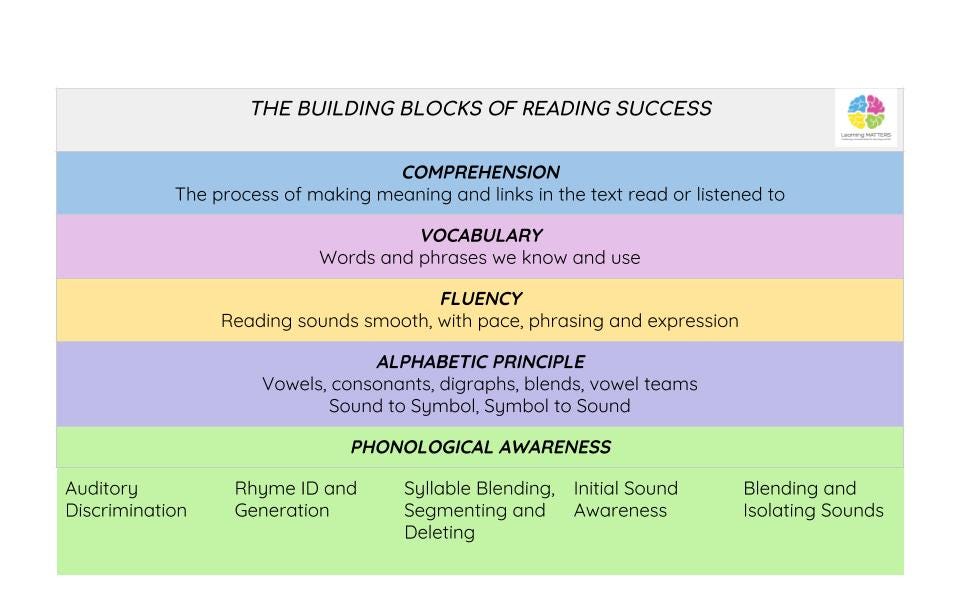
Phoneme level is the most important level of phonological awareness, the four aspects of these are:

Phoneme Identity: Helping children identify single sounds in words
Phoneme Segmentation: Break a word up into all of its individuals sounds
Phoneme Blending: Blending individual sounds together to form a word
Phoneme Manipulation: Playing with sounds and words.


The diagram below shows the building blocks of reading success: 


Reading is not creating something completely novel, reading consists of connection and creating an interface between vision and the spoken language system.

There are parts of the brain that are only activated by those who know how to read e.g. visual recognition of letters.

And perhaps the biggest message of all by Prof. Sanislas Dehaene...

Phonics is superior to whole-world training!

Image result for the brain architecture for reading

No automatic alt text available.

24 July 2018

Spiral of Inquiry: Learning about Oral Language

If you've been following my blog over the years, you will know that I have been a real advocate for Oral Language, especially in the form of Digital Storytelling.

Did you know that kids growing up in poverty hear 30 million fewer words by age 3? The 'word gap' has been a rhetoric in schools for the longest of time. Especially in South Auckland (low-socioeconomic area in New Zealand), however, this article found in MindShift challenges this widely known fact, and states that the study was done 40 years ago with only 42 families.


However, in my new role as new entrant teacher, it's pretty obvious, regardless of the study that Oral Language in our young people is in dire straits! 

I thought I knew about Oral Language, I thought I knew how to foster it, but it seems that I actually need to be more strategic and intentional in the teaching of oral language (how did it come to this?)


So I've read a range of books and watched a number of videos to explore how this might work for my class, and have created a booklet with 20 Ideas to Support Oral Language. At our recent OCoL (Otara Continuity of Learning) we looked at oral language across settings (early childhood and primary school). With my head full of ideas and possibilities I called on a team of people to help me whittle down the key practices and package all of this information into a session or programme in my class.

So our Speech Langauge Therapist (SLT), the Resource Teacher of Learning and Behaviour (RTLB), and the Psychologist met over the holidays to look at a programme. We have chosen to go with "Time to Talk" by Alison Schroeder. It looks like it will be a great way to intentionally teach oral language and create ways for whānau to be engaged too.


In addition to this, I am also enrolled in this exciting opportunity to work with a team of people and alongside Jannie Van Hees who is world-renowned for her work on oral language and vocabulary.

So, there are lots of opportunities for learning this year! I look forward to reporting on this new learning and the impact it will have on my students learning.