16 March 2018

Spiral of Inquiry - Scanning

Scanning
What’s going on for learners? More emphasis is placed on teacher observations of students, in all circumstances. There are some difficult questions to ask, such as: Is it all right for some learners to experience challenging and engaging learning in one classroom while in the room next door the students are not? Scanning is not done overnight, can last two months, and may turn up surprises.


"What strategies are most effective when supporting WRS learners with reading?" 


I have tweaked this somewhat over the past few weeks as I am conflicted by the difference between "inquiry" questions outlined by Kath Murdoch here and questions outlined here by Dr. Noeline Wright. After further investigation, it seems the "inquiry" I am used to is where there is no pre-determined 'answer or goal' rather an 'inquiry process that helps learners find out more about what they need to DO and KNOW ABOUT in order to answer a big question'.


So with this in mind, I have decided to keep my 'big question/inquiry' and create some questions that align more with the Teaching as Inquiry process here.

Big question:
"What strategies are most effective when supporting WRS learners with reading?" 

What's going on for learners?
  • I believe that oral language is the foundation to reading and writing, so have carried out JOST assessments with all of my students, areas that need attention are past tense and plurals.
  • Given that Maori/Pasifika languages do not use 'plurals' as such e.g. we say ngā waka for boat(s) there should be some explicit instruction for these areas.
  • Letter Identification and Sounds also need attention (children seem to know these through alphabetical order rather than out of context).

While test results and data systems provide information about achievement, we need to dig much deeper to find out what is happening for learners in other key areas of learning and engagement (Timperley, Kaser & Halbert, 2014, p.9)

Strengths of students:
  • Children are eager to learn and happy to engage in a range of learning experiences.
  • Children are good at following instructions
  • Happy to come to school
  • Happy to play
  • Responsible for their belongings e.g. lunch, hats and jumpers

Teacher to develop:
  • Letter sounds
  • Alphabet recognition
  • Oral language
  • Pre-reading

27 February 2018

Spiral of Inquiry

Lynne recently introduced our team to the Spiral Inquiry through a paper entitled "A framework for transforming learning in schools: Innovation and the spiral of inquiry" In this paper, the notion of inquiry is visually more representative of a true inquiry, rather than a perfect cycle of steps, the visual shows a 'spiral' I believe inquiry to be more like a 'bowl of spaghetti'.  


The six parts of the spiral of inquiry are:

Scanning
What’s going on for learners? More emphasis is placed on teacher observations of students, in all circumstances. There are some difficult questions to ask, such as: Is it all right for some learners to experience challenging and engaging learning in one classroom while in the room next door the students are not? Scanning is not done overnight, can last two months, and may turn up surprises.

Focusing
Where will concentrating our energies make the most difference? Focusing well will lead to informed actions, and usually means selecting no more than one or two areas so that the inquiry is "focused and deep". The authors point out that a common focus generates the momentum to transform schools.

Developing a hunch
How are we contributing to the situation? "Hunch" is an important word – hunches may not be totally accurate, but it is essential to get them all on the table because they guide the focusing. Sometimes they might be well-established routines of the school or the classroom, and be relevant to your own school. Hunches need testing.

New learning  
How and where will we learn more about what we do? Teacher learning must be connected to identified learner needs. External expertise is important here and the school must make clear to externals what makes a difference to learners. We all need to know why new ways of doing things are better than what we did before.

Taking action
What can we do differently to make enough of a difference? "Genuine inquiry needs space to take risks, make mistakes, and try again – and again". Changing things can also feel risky for some learners who then resist change, and in turn bring concerned parents. We need to build understanding for all, right from the outset.

Checking  
Have we made enough of a difference? Checking doesn’t have to be formal, or at a set time. It can go on throughout the spiral. The importance of trust should be a recurring theme throughout the cycle, and it certainly is true of checking.

As I progress through the year, I'll be reporting more on each step and hyperlinking these posts back to this original post.

11 February 2018

Most Likely to Suceed

Just stumbled across this video "Most Likely to Succeed" this afternoon, a groundbreaking documentary about education and curriculum reform in the 21st Century America. 

It is definitely worth watching in its entirety. You can find the full version here

06 February 2018

Guided Reading - Online Webinar


It's Saturday morning and I'm attending an online webinar on "Guided Reading". This PD is linked to my Professional Learning Inquiry (you can read about that here). I'm new to the primary setting so am very much looking forward to the challenge of walking with our tamariki (children) further in their reading journey. 

The ultimate goal of instruction is to enable readers to work their way through a text independently. Guided reading leads to the independent reading that builds the process; it is the heart of an effective literacy program.
-Fountas and Pinnell, 2016, pg. 13
Guided reading allows you to teach in a responsive way, taking into account your analysis of strengths and needs of individual readers.
-Fountas and Pinnell, 2016, pg. 17 


The steps:


Step 1: Form a small group
Generally, this is done by ability, but I'm curious as to whether this can be done by interest?

Step 2: Select and analyze a text
What ideas and concepts will be challenging for students? How will this stretch their thinking? What opportunities are there for making connections?

Ten text characteristics
  • Genre
  • Text structure
  • Content
  • Themes and ideas
  • Language and literary features
  • Sentence complexity
  • Vocabulary
  • Words
  • Illustrations
  • Book and print features
I would also add...what are the children INTERESTED in?


Step 3: Introducing the text


Step 4: Observe and interact with students
  • Teach
  • Prompt
  • Reinforce

Step 5: Invite students to discuss the text

In what ways will you invite the children to discuss the text? The following question prompts were shown and I thought they were great, will definitely be making a set for my class.


Step 6: Make teaching points

What strategies/topics/teaching points are you trying to cover in your groups?

Step 7: Word work

What opportunities can you provide for children to 'play' with words found in the story? Another cool idea offered in the workshop can be seen below.


Step 8: Writing or drawing

What are some ways we can incorporate writing or drawing into our word work block?

Step 9: Reflect and plan


Questions I am pondering: 

  • What impact does ability groups have on students attitudes towards reading?
  • What are the implications of leveling children and having this made public? (not something I want to do at all!)
  • How important is independent reading in a new entrant class?
  • How much time is dedicated to preparing for guided reading lessons?
Reflection: 
I've never in the history of my 22 years of teaching grouped children (or adults for that matter) by ability. I totally understand the reasons for this in a primary setting and of course, this is Step 1 of Creating Independent readers (based on the workshop). So, my challenge now is to actually look at this and the impact on my student's self-esteem, attitude towards reading and progress in reading.


 04 MIXED ABILITY GROUPING from BES Programme on Vimeo.


29 January 2018

The New Entrant classroom

I'm making a move..

After 22 years being an "early childhood teacher" I am making a move and taking on the role of "primary teacher". I'm excited and nervous but mostly excited about being a rookie and ready for the challenge of new learning and new ways of being.

This week I attended professional learning with Jo Williams entitled "Setting up and starting in a NE class".

Before attending the course I was ready for the first day of school! My class was all set up and I was ready to welcome new tamariki into their class. During the course Jo asked us if we had any reflections on the course. My reflection was "I thought I was ready, but maybe Im not". Such a classic teacher reaction though, our work is never done! 

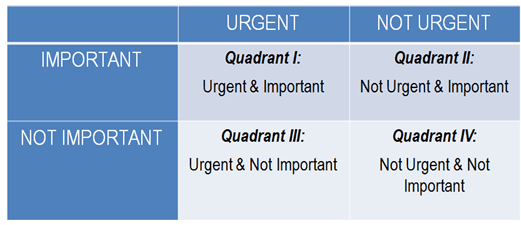
The day was an ongoing splurge of ideas and so many that I want to implement immediately. However, my goal this year is to not hit stress levels, to look after my own well-being and my whānau and make sure that I pace myself. So with all of these great ideas, Ive decided to dwindle the down into a quadrant using Stephen Covey's Time Management Quadrant. Some of these ideas I already have on my list and some of them were inspired by Jo.


Quadrant I:
  • Get to know my learners and their families
  • Identify whānau aspirations
  • Welcome sign in the door
  • Name tags
*All related to creating a sense of belonging!


Quadrant II:
  • Prepare for School Entry Assessments
  • Prepare for first round of Mutukaroa 
  • Review 'play' opportunities for students throughout the day - what areas of play am I missing?
  • Think about possible 'teacher workshops' throughout the day e.g number bingo, asking questions etc.
  • I wonder wall

Quadrant III:
  • Create math games for students
  • Source loose parts resources for class

Quadrant IV:
  • It really is hard to identify things in the 4th Quadrant. So will leave this section blank for now.

Sample of resources


Jo shared a great reading from my friend and colleague Keryn Davis, Jo highlighted the class timetable in this reading and ways that we can make it an easier transition for children and families (and teachers), such as using the first part of the morning for play-based learning.  


I had a go at drafting my Term 1 timetable (will obviously require tweaks) but I think I have a bit of a structure in place. I would love some feedback on my timetable (remember I'm new to this...) and any glaring changes that I should make.


Perhaps the most important takeaway from the day however was the link to Nathan Mikaere Wallis' work - Singing! Moving and Laughing! is the best way to get children engaged. 

My professional inquiry 2018

After reflecting on "Our codes, our standards" I have whittled my area of inquiry down for the year. My professional inquiry will be based on the Design for learning section. What immediately jumps out at me with regard to an area of focus is 'assessment'. I am moving from a sector that prioritises narrative and formative types of assessments, to a sector that has primarily based its assessments on the government requirements of National Standards - consequently an emphasis on Reading, Writing and Mathematics.
Design for learning: Design learning based on curriculum and pedagogical knowledge, assessment information and an understanding of each learner’s strengths, interests, needs, identities, languages and cultures.
Select teaching approaches, resources, and learning and assessment activities based on a thorough knowledge of curriculum content, pedagogy, progressions in learning and the learners.
My professional inquiry for the year is:


"What strategies are most effective when supporting learners with reading?" 
- Individual inquiry

Inquiry #1 - What evidence do I have that this is the right area to inquire into?
I have recently read lots of books to get my head around the assessment that is required in the first few years of school. Under the Mutukaroa framework - assessments should be completed on arrival to school (5 years), then again at 5.5 years, 6 years and 7 years. Over the holidays I delved into a few books and Youtube videos to help me prepare for these assessments in the new year. I read "An Observation survey of Early Literacy achievement" and "Effective Literacy Practice". 
I also came across suggested levels for children on the Reading Wheel. I have a lot to learn in this area! Although a quick scan of my blog will show that I have been focused on literacy for some time I am really interested in the reading progressions. I have my own philosophical views on reading, which can be found here. Over the years I've come to learn that reading has the most significant impact on student learning. Of all the things we can do for our tamariki - reading is the most important thing! What I strongly believe is that "Reading should be fun". As someone who enjoys reading ALOT! I want to foster this love of reading in children for life - not just in school. Maybe I should have been a librarian?


In my role as Mutukaroa coordinator I will be required to talk to whānau about their child's learning. While the whole area of Mutukaroa is intriguing, I really want to zone in on one particular area of learning and the impact this may have or not have on whānau engagement. How might we measure this area and what does true 'engagement' look like in the context of our school? What are our parents aspirations for their child? These are all unanswered questions that I hope to explore throughout the year. 

28 January 2018

Reflecting on the standards - 2018

Its the beginning of 2018 and Im about to start my very first class in a primary setting. I'll be taking my 22 year old early childhood hat off and putting a brand spanking new primary hat on. To say I'm excited is a bit of an understatement. I can't wait to be a rookie again!


Professional journal


It is a requirement for teachers in Aotearoa (and in my school) to keep a professional journal with evidence of growth and learning. As I have done for many years, I will be setting myself a professional inquiry based on a reflection of the very new "Our Code, Our Standards". I have grappled with various ways to show my professional growth - website, hard copy folder, Google Drive folder. I have come to the conclusion that I will keep this blog and tweak it a bit for evidence of my professional growth. You can see examples of my previous inquiries here, here, here and here.


Reflecting on the "Standards"


Te Tiriti o Waitangi partnership: Understand and recognise the unique status of tangata whenua in Aotearoa New Zealand. 

  • Understand and acknowledge the histories, heritages, languages and cultures of partners to Te Tiriti o Waitangi. 
  • Practise and develop the use of te reo and tikanga Māori. Demonstrate commitment to tangata whenuatanga and Te Tiriti o Waitangi partnership in Aotearoa New Zealand.

Reflection

I am privileged to be of Maori descent. My father is a descendant from Ngāpuhi and grew up in Kaikohe and Whangarei. I use Te Reo Maori and practice Tikanga Maori in all of my teaching practice and everyday interactions. This 'standard' is of significance to me professional and personally so I will look at further opportunities to embed this in my everyday practice.


Professional learning: Use inquiry, collaborative problem-solving and professional learning to improve professional capability to impact on the learning and achievement of all learners. 

  • Inquire into and reflect on the effectiveness of practice in an ongoing way, using evidence from a range of sources.
  • Critically examine how my own assumptions and beliefs, including cultural beliefs, impact on practice and the achievement of learners with different abilities and needs, backgrounds, genders, identities, languages and cultures. 
  • Engage in professional learning and adaptively apply this learning in practice.
  • Be informed by research and innovations related to: content disciplines; pedagogy; teaching for diverse learners, including learners with disabilities and learning support needs; and wider education matters.
  • Seek and respond to feedback from learners, colleagues and other education professionals, and engage in collaborative problem solving and learning-focused collegial discussions.

Reflection

I am addicted to learning, I am an avid reader of professional and personal books and love challenging myself to think outside the box, push boundaries and make a difference to those I teach and work with. My recent experience overseas (international teaching) was a great opportunity for me to engage with a range of people from around the world. This was a really good opportunity for me to really critique my own assumptions and beliefs about children's learning.

My recent shift from early childhood to primary education is a great example of my commitment to ongoing learning and growth. I have lots to learn with regard to 'assessment' in primary but am very much looking forward to the journey.


Professional relationships: Establish and maintain professional relationships and behaviours focused on the learning and wellbeing of each learner.

  • Engage in reciprocal, collaborative learning-focused relationships with: – learners, families and whānau – teaching colleagues, support staff and other professionals – agencies, groups and individuals in the community.
  • Communicate effectively with others.
  • Actively contribute, and work collegially, in the pursuit of improving my own and organisational practice, showing leadership, particularly in areas of responsibility.
  • Communicate clear and accurate assessment for learning and achievement information. 

Reflection

This is perhaps my strength and main area of interest. So much so, I run workshops on ways to create positive team culture for teachers in the Manukau area. I believe 'professional relationships' is vital to the success of any team, and in my experience, time invested in the culture of a team pays of two-fold. High trust, knowing your people, whats the purpose are essential for ensuring that collaboration is at an all time high.


Naku te rourou nau te rourou ka ora ai te iwi
With your basket and my basket the people will live
Again referring to co-operation and the combination of resources to get ahead. 

Learning-focused culture: Develop a culture that is focused on learning, and is characterised by respect, inclusion, empathy, collaboration and safety.

  • Develop learning-focused relationships with learners, enabling them to be active participants in the process of learning, sharing ownership and responsibility for learning. 
  • Foster trust, respect and cooperation with and among learners so that they experience an environment in which it is safe to take risks.
  • Demonstrate high expectations for the learning outcomes of all learners, including for those learners with disabilities or learning support needs.
  • Manage the learning setting to ensure access to learning for all and to maximise learners’ physical, social, cultural and emotional safety. 
  • Create an environment where learners can be confident in their identities, languages, cultures and abilities.
  • Develop an environment where the diversity and uniqueness of all learners are accepted and valued.Meet relevant regulatory, statutory and professional requirements.

Reflection

My career in education was born at the same time as Te Whariki (Ministry of Education, 1996). I have been privileged to work with a curriculum that values holistic development. Again, I have enjoyed the work in an International Baccalaureate where the Learner Profile underpins the curriculum. As I move into the primary sector, I am looking forward to using the Key Competencies to drive the learning that happens in my classroom. 

I am particularly interested this year in exploring the Kinetic Scale and Executive Function with my 5-6 year olds.


Design for learning: Design learning based on curriculum and pedagogical knowledge, assessment information and an understanding of each learner’s strengths, interests, needs, identities, languages and cultures.

  • Select teaching approaches, resources, and learning and assessment activities based on a thorough knowledge of curriculum content, pedagogy, progressions in learning and the learners.
  • Gather, analyse and use appropriate assessment information, identifying progress and needs of learners to design clear next steps in learning and to identify additional supports or adaptations that may be required.
  • Design and plan culturally responsive, evidence-based approaches that reflect the local community and Te Tiriti o Waitangi partnership in New Zealand. 
  • Harness the rich capital that learners bring by providing culturally responsive and engaging contexts for learners. 
  • Design learning that is informed by national policies and priorities.

Reflection

This is perhaps my biggest challenge and area of opportunity, I am definitely in need of digging deeper into assessment in primary e.g. BUT, JAM, CAP, LID - what do these all mean? As I am the Mutukaroa coordinator at my new school, it is essential that I get my head around assessment in the primary setting. 


Teaching: Teach and respond to learners in a knowledgeable and adaptive way to progress their learning at an appropriate depth and pace. 


  • Teach in ways that ensure all learners are making sufficient progress, and monitor the extent and pace of learning, focusing on equity and excellence for all. 
  • Specifically support the educational aspirations for Māori learners, taking shared responsibility for these learners to achieve educational success as Māori. 
  • Use an increasing repertoire of teaching strategies, approaches, learning activities, technologies and assessment for learning strategies and modify these in response to the needs of individuals and groups of learners.
  • Provide opportunities and support for learners to engage with, practise and apply learning to different contexts and make connections with prior learning.
  • Teach in ways that enable learners to learn from one another, to collaborate, to self-regulate and to develop agency over their learning.
  • Ensure learners receive ongoing feedback and assessment information and support them to use this information to guide further learning.

Reflection

I am very keen to bring play-based learning to my new setting and perhaps emphasise some of the soft skills that are required for life in general and not just reading, writing and math. There is an opportunity here with National Standards no longer in effect to ensure that arts, music, social competence are present in our children's lives.